The construction of an isometric bookmark is straightforward:
- take an index card and cut it in half
- draw a line from the center to one of the corners, as illustrated below
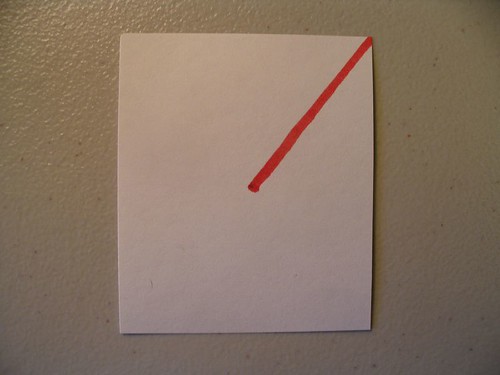
Fig. 1. Isometric bookmark
The isometric bookmark has the following property: For any line L on page P, there exists an orientation θ that uniquely identifies L on P.
In other words, by turning the card you can have it point at any line on any page – left-facing or right-facing, near the top, middle, or bottom, as shown below.
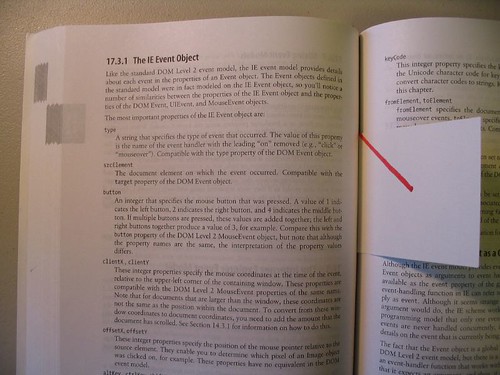
Fig. 2. Bookmarking a line near the top of a left-facing page.
There are line-based bookmarks like LastLine that you can buy at bookstores, but it's hard to beat the isomorphic bookmark for simplicity, cost, and structure-preserving topological invariance.
Excellent - I thought I was the only one dealing with this problem!
ReplyDeleteI always stop reading at the top of a page. So I don't need it for that.
But I fold the /bottom/ corners of pages for things I want to look into later. When I do that I make a bigger or smaller corner to give myself an indication of where on the page the thing I am going to investigate is.
Neat stuff Tom - scale-preserving contextual corners!
ReplyDeleteI loved reading this post! It's a wonderfully low-tech solution to a problem I thought about here.
ReplyDeleteI'm definitely going to try it out.
Sean - great! iirc you're a math guy right?
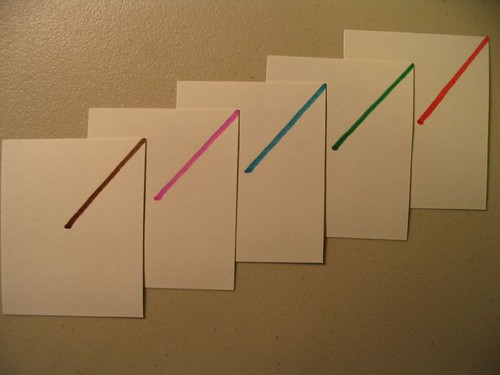
ReplyDeleteAlso I've been finding that it's best not to cut the index card - it makes the bookmark too small (hard to find).
Jonathan, you are amazing..this is a fantastic solution!Thanks
ReplyDeleteMichele
Hi Michele - My pleasure! And be sure to try leaving the index card uncut, so it's easier to find.
ReplyDeletethese post-it notes are great. point it at the word you left off on. also, they don't fall out of the book.
ReplyDelete